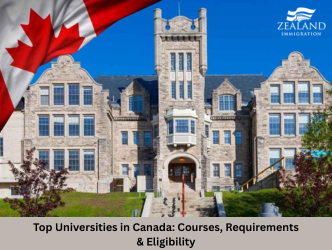
Canada education system is well-known around the world for its highly trusted and organized structure. Each year, the system attracts students all around the globe for its educational quality, exposure to global opportunities, and promising careers. Graduating from a Canadian school system is highly recognized due to the school's excellent reputation, hands-on learning experiences, and degrees worthy of international recognition.
Students in Canada are provided with a highly flexible education system, progressive educational processes, and a well-established, safe academic system. Canada presents students with a variety of educational options, from top-tier universities to methods-based to immediate career pathways. With the help of Zealand Immigration, students are able to make educated choices and boost their confidence to start their education in Canada.
Table of Contents
- Understanding the Canada Education System for Higher Studies
- Structure of Higher Education in Canada
- Types of Higher Education Institutions in Canada
- Popular Degrees Offered in the Canadian Education System
- Undergraduate Degree Programs in Canada
- Canada Master's and Postgraduate Degrees
- Postgraduate Education Canada’s Eligibility Requirements
- Canada Universities and Colleges Admission Procedures
- Why is Canada an Optimal University Choice?
- Conclusion
Understanding the Canada Education System for Higher Studies
The Canada education system is special because each province and territory manages education independently. This allows provinces to set their own rules and standards, while the overall quality of education across Canada remains consistently high.
There are a few main areas of focus in Canadian higher education:
- Good academic learning
- Practical and hands-on learning
- Research
- Experience that is relevant to the career field
Because of this, graduates of the Canada education system are well prepared for a wide range of careers and further education. Canadian institutions emphasize group work, research, and independent thinking, helping students develop the practical skills that employers value across industries.
Structure of Higher Education in Canada
In Canada, post-secondary education is clearly articulated, so students are able to progress through each level, one step at a time. After finishing secondary education, students have some post-secondary education options to choose from.
Major levels of post-secondary education are:
- Bachelor's Degrees
- Master's Degrees and other Postgraduate studies
- Doctoral (Ph.D.) programs
- Coursework at the Diploma and Certificate levels
This type of flexible intake is particularly beneficial for international students. The adaptable and organized system also assists students in Canada in developing and achieving future educational and career pathways.
Types of Higher Education Institutions in Canada
Canada has numerous options when it comes to higher education. Each education provider has their own unique set of strengths to help contribute to different academic and professional goals.
Canadian Universities
Universities in Canada primarily focus their efforts on teaching students about research and higher-order thinking. Students can earn their:
- Bachelor's
- Master's
- PhD
There is research and theory learning as well as teaching. Canadian universities are some of the best in the world, with many of them sitting atop the global rankings.
Colleges and Institutes in Canada
Colleges and institutes in Canada are mainly aimed at teaching students industry-applicable knowledge. Students in these programs can earn:
- Diplomas and certificates
- Applied degrees
- During which time they learn
- Practical and industry-applicable programs
- Work-integrated learning opportunities through co-op and internships
These are the suitable education providers for students who want to learn industry-applicable skills and want to enter the job market sooner. Many students are able to cycle through from college into university pathway programs.
Popular Degrees Offered in the Canadian Education System
Matching global job market needs, Canadian universities offer a broad spectrum of degrees, and students may select degrees according to their needs, and particular programs can be chosen as per the students' liking, workforce demand, and growth potential.
The following are some of the most common fields of study:
- Business and Management
- Engineering and Technology
- Information Technology and Computer Science
- Healthcare and Nursing
- Finance, Accounting, and Economics
- Hospitality and Tourism Management
- Environmental Studies and Sustainability
- Media, Design, and Creative Arts
Due to the worldwide recognition of Canadian degrees, students find Canadian higher education to be a good option, and students can easily engage in employment and additional education programs worldwide to advance their education.
Undergraduate Degree Programs in Canada
In Canada, undergraduate programs are the building blocks of postsecondary education. Completing a Bachelor's degree requires three to four years of study, which varies with the programs and school.
Undergraduate degrees are offered in a variety of fields, including:
- Bachelor of Arts (BA)
- Bachelor of Science (BSc)
- Bachelor of Engineering (BEng)
- Bachelor of Business Administration (BBA)
- Bachelor of Computer Science
Undergraduate students studying in Canada for degrees with:
- Teaching excellence
- More Facilities
- Library, lab, and research resource access
- A chance to work during school
These degrees provide students with extensive professional knowledge, work skills, and confidence to take on work and further education.
Canada Master's and Postgraduate Degrees
Postgraduate studies in Canada are offered to students who intend to go deeper into a field. A Master's degree takes one to two years to complete and can be course-based, research-based, or both.
The following are examples of frequently encountered postgraduate programs:
- MBA (Master of Business Administration)
- MSc (Master of Science)
- MA (Master of Arts)
- MEng (Master of Engineering)
Postgraduate level higher education in Canada concentrates on:
- Subject matter expertise
- Research proficient and analytical skillset
- Leadership and management skills
- Practical skills pertaining to the respective industry
Obtaining a master’s degree in Canada results in higher earning potential and greater job opportunities
Postgraduate Education Canada’s Eligibility Requirements
The postgraduate education eligibility criteria are dependent on the level of study, the specific program, as well as the school. Nonetheless, there are universal standards that the majority of international students are required to comply with.
Fundamental criteria set forth include:
- Completion of the previous level of education
- Academic score congruent with required standards
- Possession of English language skills demonstrated via IELTS, TOEFL, or other comparable assessments
- Academic transcripts
For postgraduate studies, the institution in question might additionally stipulate:
- Bachelor's degree in a relevant field
- Work experience (for specific programs)
- A statement of purpose and one or more letters of recommendation
With the assistance of Zealand Immigration India, students are able to better comprehend the various eligibility requirements and devise an effective application strategy.
Canada Universities and Colleges Admission Procedures
Admission procedures for higher education in Canada are designed to be student-friendly and straightforward; however, they contain numerous steps which students must rigorously adhere to.
The process of admission generally consists of the following steps:
- Choosing one course and one institution
- Collection of all relevant and additional documents
- Deadline adherence for submission of said documents
- Receipt of admission offer
- Engagement with the offer, followed by payment of the tuition deposit
- Engagement with the Canada study permit application
With regard to international Students applying to Canadian University and college Systems, Application Processes are primarily carried out through the internet. For those students with access to professional service providers, there is the potential for minimal stress and optimal process efficiency.
Why is Canada an Optimal University Choice?
Reasons for the selection of Canada as an optimal University choice from an international student perspective include, but are not limited to, the following:
- Substantial educational value that is recognized globally
- Tuition costs that are less compared to competing countries
- Employment opportunities that are recognized during and post-study
- Supportive of an international and diverse population
- Post-study opportunities available
The ability to study in another country is a privilege that few people are afforded, and in Canada, Students will have the opportunity to interact with diverse groups of people. The ability to study in another country is a privilege that few people are afforded.
Conclusion
The Canada education system stands out for its quality, flexibility, and global recognition. With a wide range of higher education institutions, including universities and colleges, Canada offers students multiple pathways to achieve their academic and career goals. Higher education in Canada focuses not only on strong theoretical knowledge but also on practical learning, research, and industry exposure, which helps students succeed in a competitive global job market.
From undergraduate programs to advanced postgraduate degrees, students who Study in Canada gain access to world-class education, modern facilities, and valuable international experience. Understanding the structure of the system, available degrees, eligibility requirements, and admission process allows students to make confident and informed decisions.