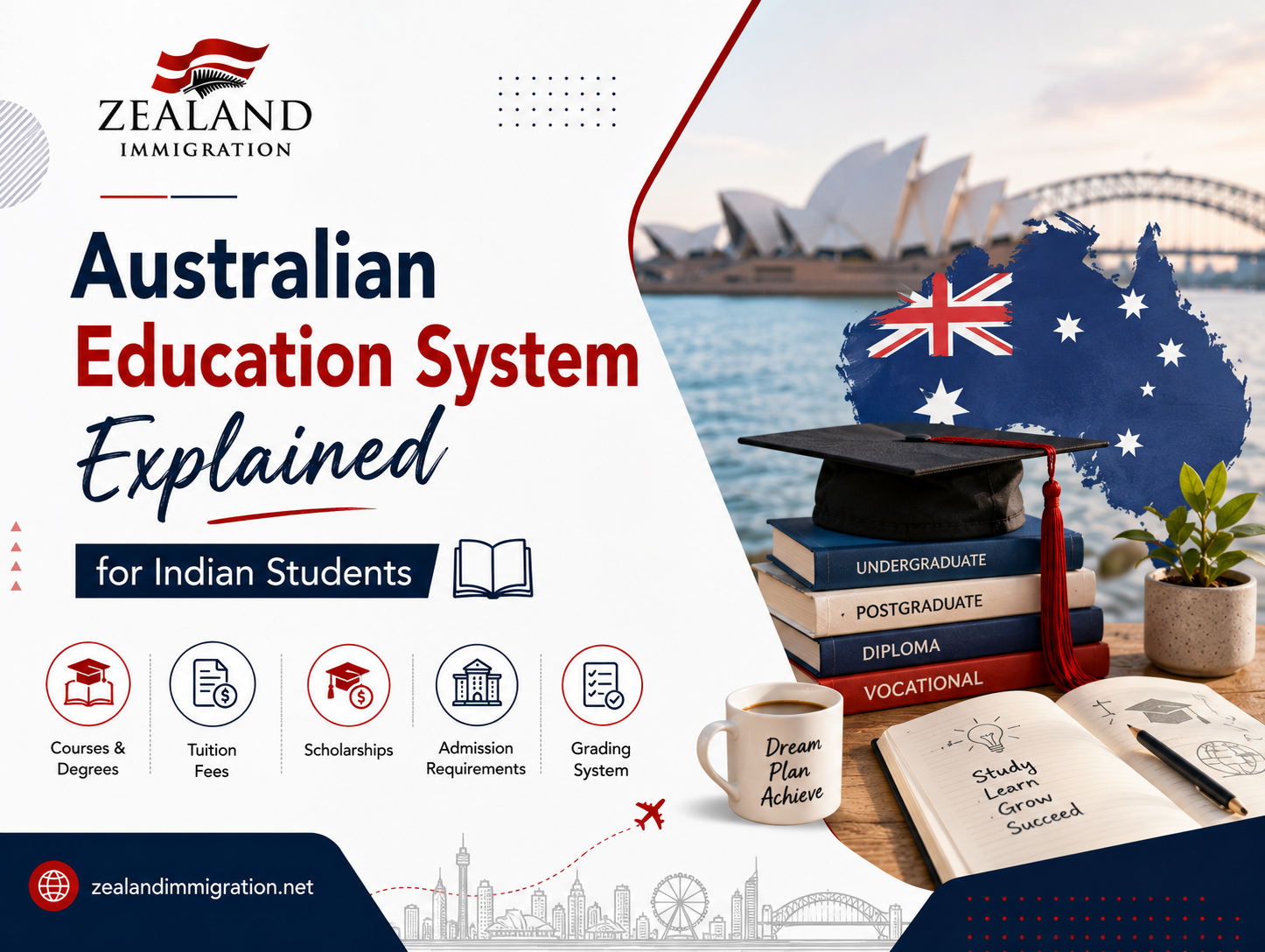
If you've been thinking about studying abroad, Australia has probably come up more than once. Between the universities, the lifestyle, and the career options that open up afterward, it's one of the most talked-about destinations among Indian students right now. Before packing your bags, though, it helps to understand how the Australia education system works: how schooling is structured, how grading differs from back home, and what the admissions process really involves. That's what this guide covers.
Table of Contents
- Higher Education in Australia: Why Indian Students Choose It
- Structure of the Australia Education System
- Understanding the Australian Qualifications Framework (AQF)
- Higher Education (University Level)
- Australian Grading System Explained
- Popular Courses for Indian Students in Australia
- Admission Requirements for Indian Students to Study in Australia
- Cost of Education in Australia
- Scholarships for Indian Students in Australia
- How Zealand Immigration India Can Guide Your Journey
Higher Education in Australia: Why Indian Students Choose It
There isn't one single reason students pick Australia. It's usually a mix of things:
- Universities that show up consistently in global rankings
- Qualifications recognised by employers around the world
- Multicultural cities that make settling in easier
- Post-study work rights and a real path toward permanent residency
- Part-time work options while studying, which help cover expenses
- Strong industry ties that make finding work after graduation a little easier
Structure of the Australia Education System
Australian education is split into a few stages, each with its own standards.
Primary and Secondary Education
Schooling starts around age five and runs for about thirteen years. Primary school covers Kindergarten through Year 6, and secondary picks up from Year 7 to Year 12. The last two years matter most, since that's when students work toward their Senior Secondary Certificate, which acts as the gateway to university.
Most Indian students won't deal with this part directly, but it helps to know what local students go through before reaching university age.
Understanding the Australian Qualifications Framework (AQF)
A lot of students only look into this later, though it helps to understand it early. The AQF ties school certificates, vocational courses, and university degrees together into one structure with ten levels, from basic certificates up to a doctorate.
This matters because it:
- Keeps standards consistent, so a degree from Sydney means the same thing as one from Perth or Melbourne
- Helps you figure out which qualification level fits your goals, since a diploma can sometimes get you into the workforce faster than a full degree
- Makes comparing Indian qualifications to Australian ones far less confusing
Higher Education (University Level)
This is where most Indian students enter the picture:
- Bachelor's degrees: three to four years
- Master's programs: one to two years
- Doctoral study: three to four years of research
VET (Vocational Education and Training) courses: practical skills for fields like hospitality, IT, and various trades
Some students start with a diploma and later transfer those credits into a bachelor's degree. It can work out cheaper and quicker than starting with a full degree.
Australian Grading System Explained
This part confuses a lot of students at first since it's nothing like the percentage system used in India:
- High Distinction (HD) for exceptional work
- Distinction (D) for strong performance
- Credit (C) for solidly above average work
- Pass (P) for meeting requirements
- Fail (F), which speaks for itself
Most universities also calculate a GPA out of 7, while some use marks out of 100. If scholarships or honours programs matter to you, getting an early equivalence assessment helps you know where you stand.
Popular Courses for Indian Students in Australia
Certain subjects come up again and again when Indian students talk about what they're studying:
- Business and management
- Engineering
- Information technology
- Nursing and other healthcare fields
- Data science and analytics
- Cybersecurity
- Renewable energy
- Artificial intelligence
Most of these line up with Australia's current skills shortages. Picking a course that's in demand tends to make things easier once you're looking for work or applying for a post-study visa.
Admission Requirements for Indian Students to Study in Australia
Every university has its own quirks, but generally you'll need:
- A completed application
- Academic transcripts
- English test scores such as IELTS, PTE, or TOEFL
- A Statement of Purpose
- Recommendation letters, mainly for postgraduate courses
- A Genuine Temporary Entrant (GTE) statement
- Proof of financial capacity for the course
Getting these right the first time makes the visa process go much smoother. Whether you plan to Study in Australia for a diploma, a bachelor's degree, or a master's program, sorting out these documents early takes a lot of pressure off later on.
Cost of Education in Australia
This is probably the question most people want answered. The real answer depends on the university, the course, and the city. That said, here's roughly where the money goes:
- Undergraduate tuition, which varies by specialisation
- Postgraduate tuition, usually higher, especially for research-heavy programs
- Day-to-day living costs like rent, food, and transport, which vary a lot between big cities and regional towns
- Health insurance (OSHC), mandatory but relatively affordable
- A one-time visa application fee
Getting a proper cost estimate for your specific university and course is a better approach than guessing.
Scholarships for Indian Students in Australia
Cost doesn't have to come entirely out of pocket. A few options worth looking into:
- Australia Awards scholarships
- The Destination Australia Scholarship
- Merit-based scholarships offered directly by individual universities
- Partial fee waivers, which some universities offer to strong Indian applicants
Deadlines for these tend to come up fast, so starting the research early makes a real difference.
How Zealand Immigration India Can Guide Your Journey
Choosing the right course, sorting out paperwork, and figuring out visa requirements can get overwhelming fast. That's where having support helps. Our team works with students to:
- Shortlist universities and courses that fit their goals and budget
- Put together applications that are accurate the first time
- Make sense of what Higher Education in Australia actually looks like
- Decide between a diploma pathway and a direct bachelor's entry
- Prepare for the student visa interview without last-minute panic
Australia remains one of the strongest options for Indian students who want a solid education and real career prospects afterward. With good planning, the journey can turn out a lot smoother than expected.
Our Popular Study Abroad Destinations: