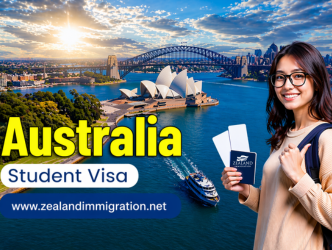
Every year, thousands of Indian students pack their bags and head to Australia, and honestly, it is not hard to see why. The universities are excellent, the cities are liveable, the work opportunities after graduation are real, and the overall experience of studying there tends to shape people in ways that stay with them long after they graduate.
But none of that happens without first clearing the visa process. And that part? It trips up more students than it should, not because the process is impossibly hard, but because people underestimate how much small documentation errors can cost them. A missing certificate here, an inconsistent date there, and suddenly your application is delayed by weeks or rejected outright.
So, before you get to the exciting part of shortlisting courses, researching cities, picturing yourself on a university campus, let us walk through exactly what goes into a solid Australia student visa application.
Table of Contents
- Australia Student Visa Subclass 500: What It Is and Who Needs It
- Mandatory Documents Required for Australia Student Visa Application
- 1. Valid Passport
- 2. Confirmation of Enrolment (CoE)
- 3. Genuine Temporary Entrant (GTE) Statement
- 4. Academic Certificates and Transcripts
- 5. English Language Test Scores
- 6. Proof of Financial Capacity
- 7. Overseas Student Health Cover (OSHC)
- 8. Medical Examination Certificate
- 9. Police Clearance Certificate (PCC)
- 10. Recent Passport-Size Photographs
- Additional Documents That Can Strengthen Your Visa Application
- Student Life in Australia: Cost, Work Rights and What to Expect
- Important Tips to Avoid Common Visa Application Mistakes
- Why Indian Students Trust Zealand Immigration for Australia Visa Guidance
- Is Studying in Australia Worth It? Here Is What You Should Know
- Start Your Australia Journey Today - Book a Free Consultation with Zealand Immigration
Australia Student Visa Subclass 500: What It Is and Who Needs It
The student visa for Australia falls under Subclass 500. It covers full-time study at any registered institution, whether you are doing a bachelor's, a postgraduate degree, a diploma, or a vocational programme. Everything is submitted online through the Department of Home Affairs, and the strength of your application depends almost entirely on what documents you include and how well they hold together.
Australia takes its education system seriously. Institutions here are regulated under TEQSA, the Tertiary Education Quality and Standards Agency, which means the degree you earn actually carries weight internationally. The Australia education system is not just respected; it is structured to push students toward real industry outcomes. That is a big part of why Australian universities like Melbourne, Sydney, ANU, and Monash continue to attract students from over 190 countries every single year.
When you factor in the quality of campus life, the research facilities, and the career networks these universities maintain, it becomes clear why getting the visa right is worth every bit of effort.
Mandatory Documents Required for Australia Student Visa Application
1. Valid Passport
This one seems obvious, but it catches people off guard more than you would think. Your passport must cover the entire length of your stay, not just your course duration, but any buffer time you plan to take before or after. Check the expiry date. Check that you have blank pages for endorsements. If it is running close, renew it now rather than scrambling later.
2. Confirmation of Enrolment (CoE)
Your CoE is the document your Australian institution issues after you have accepted your offer and made the initial fee payment. Without it, there is nothing to process. If you are planning to do two courses back to back, say, a diploma followed by a degree, you will need a separate CoE for each. Keep them both ready.
3. Genuine Temporary Entrant (GTE) Statement
This is the document that most students either underestimate or overthink. The GTE is your written explanation of why you want to study in Australia, what you plan to do when you return home, and why your intentions are genuine. Immigration officers read these closely. A response that feels copy-pasted or overly formal tends to raise more questions than it answers. Write it in your own voice, be specific about your situation, and make sure it actually connects to your academic and career goals.
4. Academic Certificates and Transcripts
You will need certified copies of your Class 10 & 12 mark sheets, degree certificates (if applicable), and transcripts from each school or university you attended, in order to verify that you have met the academic prerequisite of your Australian educational institution.
5. English Language Test Scores
You will need a score for either the IELTS, PTE Academic or TOEFL iBT, Cambridge C1 Advanced (whichever exam you took), as the required scores for different levels of study and institutions can vary; thus, it is advisable that you find out what is expected by your specific university.
6. Proof of Financial Capacity
This is where applications fall apart most often. You need to show you can cover tuition for the first year, living costs of roughly AUD 21,041 per year under current Department of Home Affairs guidelines, and return travel. Bank statements from the past six months work well, as do fixed deposit certificates, scholarship letters, or a loan sanction from a recognised bank. If a parent or relative is funding your studies, their financial documents and a sponsor letter need to be included, too.
7. Overseas Student Health Cover (OSHC)
OSHC is not optional. It is mandatory for your entire visa period and must be active from the day your visa begins. Many Australian universities arrange it as part of the admission process; check your offer letter, because it may already be sorted.
8. Medical Examination Certificate
Depending on your nationality and course length, you might need a health check with a panel physician approved by the Australian government. If this applies to you, book it early. Results go directly to the Department of Home Affairs, and delays here can hold up your entire application.
9. Police Clearance Certificate (PCC)
A PCC from India is required for applicants aged 16 and above. You can get it through your local police station or the regional passport office. If you have lived in another country for more than 12 months over the past decade, you will likely need a PCC from there as well.
10. Recent Passport-Size Photographs
Digital submission still requires photos. Get recent passport-size photographs that meet the Department of Home Affairs specifications do not use old pictures or ones cropped from informal shots.
Additional Documents That Can Strengthen Your Visa Application
Once you have the mandatory pile sorted, a few additional documents can genuinely strengthen your case.
A well-written Statement of Purpose goes a long way, especially for postgraduate applicants. Unlike the GTE, which focuses on your temporary intent, the SOP covers your academic journey, career goals, and why this particular course makes sense for where you are headed. Specific and honest always beats generic and impressive-sounding.
Work experience letters matter if you are applying for a professional or postgraduate programme. They show a clear thread between your background and your chosen field, which adds credibility to both your application and your GTE.
Student Life in Australia: Cost, Work Rights and What to Expect
Getting the visa is the goal right now, but it helps to know what is waiting. Living in Australia as an international student is genuinely comfortable, more so than many students expect before they arrive. Cities like Melbourne, Sydney, Adelaide, and Brisbane have well-connected public transport, student-friendly areas near most campuses, and large, well-established Indian communities that make settling in far less daunting.
Cost-wise, most students spend somewhere between AUD 1,400 and AUD 2,500 per month, depending on the city and lifestyle. The student visa lets you work up to 48 hours per fortnight during term time and unlimited hours during official breaks, which means covering day-to-day expenses without relying entirely on family support is entirely doable.
Between OSHC covering your healthcare needs, strong student support services on campus, and the sheer quality of everyday life, living in Australia is not just manageable, it is one of the best parts of the whole experience.
Important Tips to Avoid Common Visa Application Mistakes
Start at least two to three months before your course begins. The Department of Home Affairs technically asks for a month's notice, but buffer time saves you from stress if additional documents are requested.
Every non-English document needs a certified English translation. Skipping this means those documents simply do not get processed.
Before you hit submit, read your GTE and SOP against the rest of your documents. Dates, names, course details, stated intentions, everything should line up. Even small inconsistencies can create doubts that delay or derail your application.
Why Indian Students Trust Zealand Immigration for Australia Visa Guidance
Most students who come to us have already spent weeks trying to make sense of the process on their own and arrive either overwhelmed, holding a half-complete application, or recovering from a rejection they did not see coming. All of that is understandable. The requirements are detailed, the stakes are high, and there is not much room for trial and error when your academic timeline is involved.
At Zealand Immigration India, we have spent years helping Indian students get their Australia student visa right the first time. We know the Australia education system, we know what Australian universities need from applicants, and we know how to build an application that holds up. From GTE statements to financial documentation to SOPs, we treat every case with the attention it actually deserves.
Whether you are applying for the first time or trying again after a refusal, our team is here.
Is Studying in Australia Worth It? Here Is What You Should Know
The Australian universities are genuinely world-class. The Australia education system is designed for real outcomes. And living in Australia, the people, the culture, and the sheer livability of it have a quality that is hard to find elsewhere. But none of it begins without a clean, complete, well-thought-out visa application.
Go through this checklist carefully. Give every document the seriousness it deserves. And if you want someone experienced in your corner, we are here.
Start Your Australia Journey Today - Book a Free Consultation with Zealand Immigration
You do not have to piece this together alone. Our counsellors will review your documents, help shape your GTE and SOP, and make sure your Australia student visa application goes in strong, no gaps, no guesswork.
Get in touch today and take your first real step toward living and sudy in Australia.