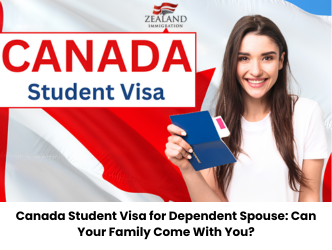
Studying abroad is one of the most life-changing decisions a person can make. But when you are married or have a family, the question that comes up just as quickly as the Canada Student Visa requirements is this, do you have to leave your loved ones behind? The good news is that Canada has some of the most family-friendly immigration policies in the world, and yes, your spouse can come with you.
Canada genuinely welcomes international students and their families. The country understands that being separated from a spouse for one, two, or even three years is a difficult ask. That is why the immigration system has been designed in a way that gives your dependent partner real, meaningful options, not just the chance to sit at home, but to actually work and build a life alongside you.
Table of Contents
- Who Qualifies as a Dependent Spouse Under Canada's Immigration Rules?
- The Open Work Permit: A Game-Changer for Accompanying Spouses
- How the Application Process Works
- Financial Proof: What Canada Wants to See
- What About the Canada Family Visa?
- Living Together While Studying: What to Realistically Expect
- Get Expert Help Before You Apply
Who Qualifies as a Dependent Spouse Under Canada's Immigration Rules?
Before anything else, it helps to understand who Canada recognises as a dependent spouse. IRCC (Immigration, Refugees and Citizenship Canada) considers a spouse to be a legally married partner. Common-law partners, those who have lived together in a conjugal relationship for at least 12 months, are also included. This is a significant detail for many couples who are not formally married but have been in a committed relationship for a year or more.
Canada does not currently extend open work permit eligibility to dependent children or other family members under this stream. The provisions we are discussing here apply specifically to the accompanying spouse or common-law partner of an international student.
The Open Work Permit: A Game-Changer for Accompanying Spouses
If your spouse comes to Canada with you, they are not restricted to staying home. Under Canada's spousal open work permit, eligible partners of international students can apply to work in Canada without needing a job offer first. This is a genuinely open permit your spouse to work for virtually any employer, in almost any industry, anywhere in the country.
This makes the Spouse Visa Canada route one of the most practical immigration pathways available for married students. Your spouse can help you generate income for the family while giving you support as a spouse and helping you gain work experience in Canada with your student. In turn, this will also help your spouse develop their own professional contacts and network.
The key eligibility condition here is the length and level of your study program. Your spouse's open work permit eligibility is generally tied to you being enrolled in a full-time program at a Designated Learning Institution (DLI) that is a post-secondary institution at the college or university level.
How the Application Process Works
The process for bringing your spouse to Canada is more straightforward than many people assume. Both applications, your study permit and your spouse's temporary resident visa or work permit, can often be submitted together at the same time, which saves considerable time and avoids the anxiety of staggered approvals.
Here is a general overview of how it typically works:
- You apply for your Canada Student Visa (study permit) after receiving your acceptance letter from a DLI.
- Your spouse simultaneously applies for a Temporary Resident Visa (TRV) or an Electronic Travel Authorisation (eTA), depending on their nationality.
- Once in Canada, your spouse can then apply for an open work permit, usually at the port of entry or from within Canada after arrival.
- Both of you will need to meet biometric requirements and provide supporting documents such as proof of relationship, financial evidence, and your study permit details.
The specific documents required will vary depending on your spouse's country of origin, whether they need a visa to enter Canada, and your own application circumstances. Working with an experienced immigration consultant can make this process significantly smoother and help you avoid delays.
Financial Proof: What Canada Wants to See
One of the most important parts of any family-based immigration application is demonstrating that you can financially support both yourself and your spouse during your time in Canada. IRCC wants to be confident that neither of you will become reliant on Canadian public funds.
As a general guide, you will need to show funds to cover your tuition fees for the first year, living costs for yourself and your spouse (this is over and above tuition), and return travel costs for both of you. The exact amounts fluctuate, so it is worth checking the current IRCC guidelines or speaking to an advisor who can give you figures specific to the province you plan to study in.
What About the Canada Family Visa?
It is worth being clear about the distinction between a Canada Family Visa and the spousal work permit route under a student visa. The Canada Family Visa typically refers to applications made under family sponsorship, a permanent resident or Canadian citizen sponsoring a family member for PR. That is a separate and longer pathway.
What we are discussing here a spouse accompanying a student on a temporary basis falls under the temporary resident category. It is not a permanent residence application. However, it does put your family on Canadian soil, with your spouse gaining legitimate work experience, which can later be used towards PR pathways like Express Entry or Provincial Nominee Programs if you choose to stay long-term.
Living Together While Studying: What to Realistically Expect
Having your spouse with you in Canada changes the experience of studying abroad entirely. Many students find they settle in faster, manage stress better, and stay more focused on their studies when their partner is with them. Having someone familiar in an unfamiliar country has a real psychological benefit that is easy to overlook when you are in the planning stage.
That said, it does require practical preparation. Finding accommodation for two people, budgeting for shared living costs, and helping your spouse settle into a new country while you are adjusting to a new academic environment is a lot to manage at once. Starting the visa process early, ideally as soon as you have your admission letter, gives you the best chance of having everything in order before you depart.
Get Expert Help Before You Apply
Canada's immigration system is detailed, and small errors in applications, a missing document, an incorrect form, or insufficient financial evidence can result in refusals or long delays that push back your start date. If you are planning to bring your spouse along, the stakes are even higher because you are managing two applications simultaneously.
The team at Zealand Immigration India has years of hands-on experience helping students and their families navigate the Canadian immigration system. From reviewing your documents to submitting a complete and accurate application, professional guidance can make the difference between a smooth arrival and months of uncertainty.
Canada is one of the very few study destinations in the world where your spouse is not just welcome, but genuinely supported. Take advantage of that, plan ahead, and make the move together.